3D Printing in the Automotive Industry: Applications and Benefits
[Watch our 3D printer in action – printing an automotive bumper.]
In recent years, 3D printing technology has achieved remarkable success in various industries, and the
automotive industry is no exception. From rapid prototyping to the production of end-use parts, 3D printers
are reshaping the way automotive manufacturers design, prototype, and produce components. The ability
to print parts on demand, reduce costs, and streamline production processes is driving innovation in the
automotive industry.
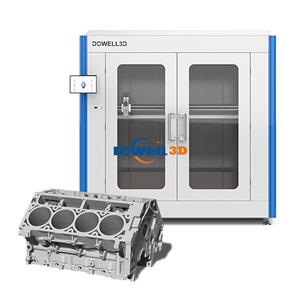
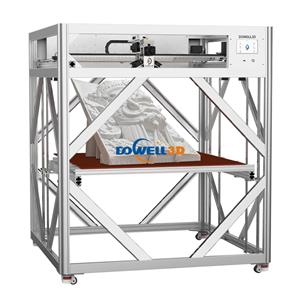
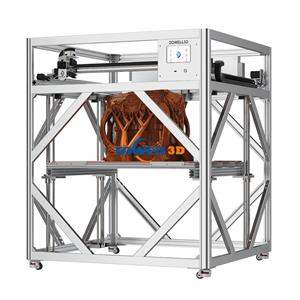
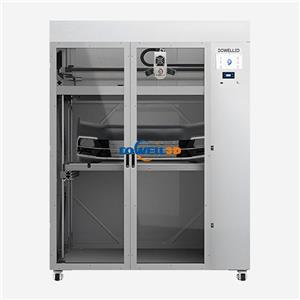
At DOWELL3D, we have over 11 years of experience in producing high-quality 3D printers and filaments, trusted
by manufacturers worldwide. Our leading technology enables automotive companies to stay ahead of the curve,
providing efficient, sustainable, and cost-effective solutions for modern automotive manufacturing needs.
In this article, we will explore the key applications of 3D printing in the automotive industry, how they address
common pain points, and why DOWELL3D is the ideal choice for automotive manufacturers looking to leverage
3D printing technology.
1. Rapid Prototyping and Design Validation
One of the most significant advantages of 3D printing in the automotive industry is its ability to facilitate rapid
prototyping. Traditionally, prototyping required expensive molds, long lead times, and high material costs.
3D printing, using filaments such as ABS, PLA, and PETG, allows automotive designers to quickly iterate on designs
and test the functionality and assembly of various components without the need for expensive molds.
By using 3D printers, designers can create functional prototypes in just a few hours, instead of the weeks it used
to take, significantly shortening time to market and accelerating the entire product development cycle. This also
allows manufacturers to quickly identify and resolve design flaws before mass production, which is crucial in fast-
paced and highly competitive industries such as automotive manufacturing.
Key Benefits:
Faster design iteration with less time spent on prototyping.
Cost-effective production with no need for expensive molds.
Testing and validation of designs in real-world conditions.
2. Custom Parts and Components for Automotive Manufacturing
While one of the most significant applications of 3D printing in the automotive sector is rapid prototyping, it is
also increasingly being used to produce end-use parts for automobiles. Automotive manufacturers are turning to
filament-based 3D printing technology to create lightweight, durable, and functional custom parts. For example,
air ducts, custom fittings, and even interior components (such as dashboard components) can be printed using
filament materials such as ABS or nylon, providing unique solutions for specific design requirements.
For example, manufacturers can print complex geometric shapes that are difficult to achieve with traditional
injection molding. This makes it easier to produce parts that fit into unconventional spaces, thereby reducing
the overall weight of the vehicle and ultimately improving fuel efficiency.
Key Benefits:
Customizable designs for specific vehicle models.
Lightweight parts for improved fuel efficiency.
Enables the creation of complex geometric shapes not possible with traditional manufacturing processes.
3. Tooling and Production Aids in Automotive Manufacturing
In addition to being used for manufacturing automotive parts, filament-based 3D printing technology is also used
to produce specialized tools, jigs, and fixtures used in the manufacturing process. These production aids can be
customized as needed to improve efficiency and precision during assembly or parts handling.
By using filament to create these tools, manufacturers can reduce the cost and lead time associated with producing
custom tools. For example, creating a jig for part alignment or a fixture to hold components in place during assembly
can be done quickly with 3D printing, allowing manufacturers to adapt to new production needs without waiting for
custom tooling to be produced.
Key Benefits:
Custom tooling that improves precision in the manufacturing process.
Faster production setup times, as tools can be printed on-demand.
Cost-effective solutions for low-volume or short-run production.
4. Spare Parts and On-Demand Production
In traditional manufacturing, producing automotive parts typically requires maintaining large inventories of
components, which consumes significant resources and storage space. 3D printing technology offers a solution
to this problem by enabling on-demand production of parts. Using 3D printing materials, manufacturers can print
parts as needed, significantly reducing inventory costs and the need for large-scale warehousing.
This on-demand production approach is especially useful for older vehicle models or niche parts that are no longer
in mass production. Instead of waiting weeks for a part to be shipped, manufacturers and repair shops can print the
part they need within hours, making maintenance more efficient and reducing downtime.
Key Benefits:
Reduced storage costs by eliminating the need for large inventories.
Quick turnaround for spare parts, reducing vehicle downtime.
Access to hard-to-find parts for older or rare vehicles.
5. Sustainability in Automotive Manufacturing
Sustainable development is a key focus for the automotive industry today, and manufacturers are actively seeking
ways to reduce waste and improve energy efficiency. Using wire for 3D printing helps achieve this goal because it
minimizes material waste. Traditional manufacturing methods, such as injection molding, often generate significant
amounts of waste material. In contrast, 3D printing uses only the material needed to build the part, thus reducing
waste in the production process.
Additionally, filament materials like PLA are biodegradable and made from renewable resources, making them a
more eco-friendly choice. The ability to produce only the parts needed also reduces the carbon footprint associated
with transportation and shipping, as fewer parts need to be stored and shipped globally.
Key Benefits:
Reduced material waste thanks to the additive nature of 3D printing.
Eco-friendly materials like PLA that reduce the environmental impact.
Lower carbon footprint due to on-demand, localized production.
How to Choose the Right 3D Printer for Automotive Manufacturing?
Choosing the right 3D printer for automotive manufacturing requires considering several key factors.
The following list outlines the most important considerations:
Print Volume:
The size of the print volume determines the maximum part size you can produce in a single print.
Material Compatibility:
Ensure the printer can use the materials you require, such as ABS, PLA, carbon fiber, etc.
Print Speed:
High-speed printers can significantly reduce production time, which is crucial for meeting tight deadlines.
Precision and Accuracy:
High precision and accuracy are essential for functional prototypes and end-use parts.
Ease of Use:
A user-friendly interface and low maintenance requirements can improve productivity and reduce downtime.
Cost:
Consider both the initial cost of the printer and the long-term operating costs, including materials and maintenance.
Scalability:
Choose a printer that can scale with your production needs, whether for prototyping or mass production.
Support and Service:
Reliable customer support and service can help you quickly resolve issues and ensure your production runs smoothly.
With over 11 years of experience in manufacturing high-quality 3D printers and filaments, DOWELL3D is a trusted
brand in the 3D printing industry. We offer a range of durable and reliable 3D printers and specialized filaments
designed to meet the unique needs of the automotive industry. Whether you're prototyping new automotive parts,
producing custom components, or manufacturing production aids, DOWELL3D provides the tools you need to stay
ahead of the competition.
Choose DOWELL3D and gain access to innovative 3D printing solutions that will drive your automotive manufacturing
business forward.