Industrial 3D Printer Trends: Production, Not Prototypes
For years, 3D printing had a fairly simple reputation in manufacturing.
Design something.
Print a prototype.
Check the fit.
Make a few changes.
Print it again.
That workflow is still useful, but it no longer tells the whole story.
In 2026, more manufacturers are looking at 3D printing from a different angle: Can it actually help us make
the parts we need, in the quantities we need, without adding another expensive step to the production process?
That change matters.
The conversation around an industrial 3d printer is moving away from simply asking how accurately a machine
can reproduce a CAD model. Instead, manufacturers are asking about cycle time, repeatability, operating cost,
part size, machine utilization, production flexibility, and whether the printer can run reliably for hours at a time.
The prototype is still important.
But increasingly, it is not the final destination.
The Industrial 3D Printing Market Is Becoming More Production-Focused
The numbers tell part of the story.
According to the 2026 Wohlers Report, the global additive manufacturing market generated approximately
$24.2 billion in revenue in 2025, up 10.9% from the previous year. More importantly, printing services represented
48% of the total market, showing how much of the industry's value is connected to actually producing parts
rather than simply selling machines.
Another market analysis from Additive Manufacturing Research put the 2025 3D printing and additive manufacturing
market at about $16.0 billion, representing 10.2% year-over-year growth.
The exact market size varies depending on what is included in each report, but the direction is much more interesting
than the difference in numbers.
3D printing is becoming a manufacturing capability.
And that changes what buyers expect from a 3d printer.
A production machine needs to do more than produce one impressive sample at a trade show. It needs to perform
the same basic job repeatedly, with predictable results.
From "Can We Print It?" to "Can We Produce It?"
This may be the biggest change in the industry.
A few years ago, the first question was often:
"Can a 3d printer make this part?"
Today, the better question is:
"Can a 3d printer make this part reliably enough to be part of our manufacturing process?"
Those are two very different questions.
A successful prototype proves that a design is printable.
A successful production process proves that the design can be made repeatedly while keeping time, quality, labor,
and cost under control.
For manufacturers, the second problem is much harder.
A production-oriented industrial 3d printer therefore needs to fit into the workflow around it.
That means CAD preparation, slicing, machine setup, printing, inspection, finishing, assembly, and sometimes
direct integration with other manufacturing processes.
The printer is no longer an isolated machine sitting in an R&D room.
It becomes part of the production floor.
Why Large Parts Are Driving a Different Kind of 3D Printing
One of the most interesting areas of this transition is large-format additive manufacturing.
Traditional 3D printing is often associated with relatively small components. But manufacturers do not always
need small parts.
They need:
large jigs
assembly fixtures
molds
tooling
machine covers
automotive components
furniture components
architectural models
industrial housings
replacement parts
production aids
full-size prototypes
customized end-use components
This is where a large format 3d printer becomes much more interesting.
If a component is too large for a conventional machine, there are usually only a few options: redesign it into
smaller pieces, outsource it, use traditional fabrication, or invest in a machine capable of producing the part in-house.
Splitting a large component into multiple sections can solve the size problem, but it introduces joints.
More joints mean more assembly.
More assembly means more labor.
And every additional connection creates another opportunity for dimensional error.
Printing a larger component in fewer pieces—or even as one piece when practical—can simplify the manufacturing
process.
That is one reason large-format printing is gaining attention beyond prototyping.
Production Does Not Always Mean Mass Production
There is another misconception worth clearing up.
When manufacturers hear "production," they sometimes think about tens of thousands of identical parts.
That is not necessarily where industrial 3D printing has the strongest advantage.
A better fit is often low-volume or medium-volume production with high variation.
Think about a company producing:
replacement machine parts
custom equipment
specialized fixtures
motorsport components
marine components
customized furniture
industrial tooling
short-run products
spare parts
engineering components
Traditional mass-production methods can be extremely efficient once volume is high enough.
But getting there can require tooling, molds, fixtures, setup time, and minimum order quantities.
Additive manufacturing has a different advantage.
You can change the digital file.
Then you make the next version.
No new mold is required simply because the geometry changed.
For businesses dealing with customized or frequently changing products, that flexibility can be more valuable
than maximum output per hour.
Large Format 3D Printer Buyers Are Looking Beyond Build Volume
Build volume is still important.
But experienced buyers are starting to look beyond the headline number.
A machine may have a huge build area, but that does not automatically make it a good production machine.
The real questions are:
How stable is the machine during a long print?
How consistent is the extrusion?
Can it maintain dimensional accuracy over a large build area?
How quickly can the machine produce a usable part?
What happens if a print fails after 30 hours?
Can operators monitor the machine remotely?
How easy is it to repeat a successful print?
These questions are much closer to the concerns of a production manager than a hobbyist.
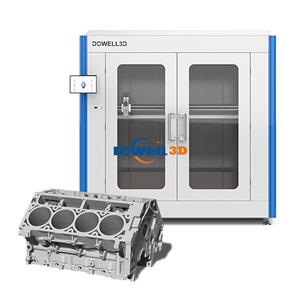
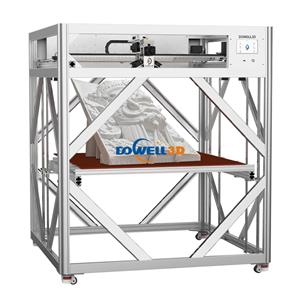
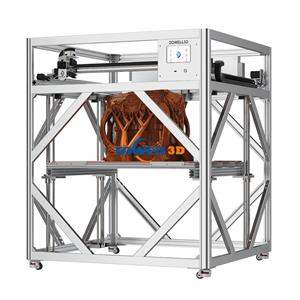
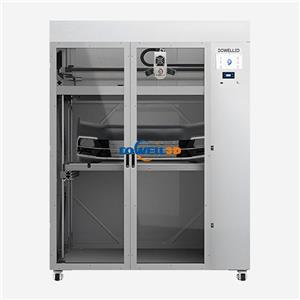
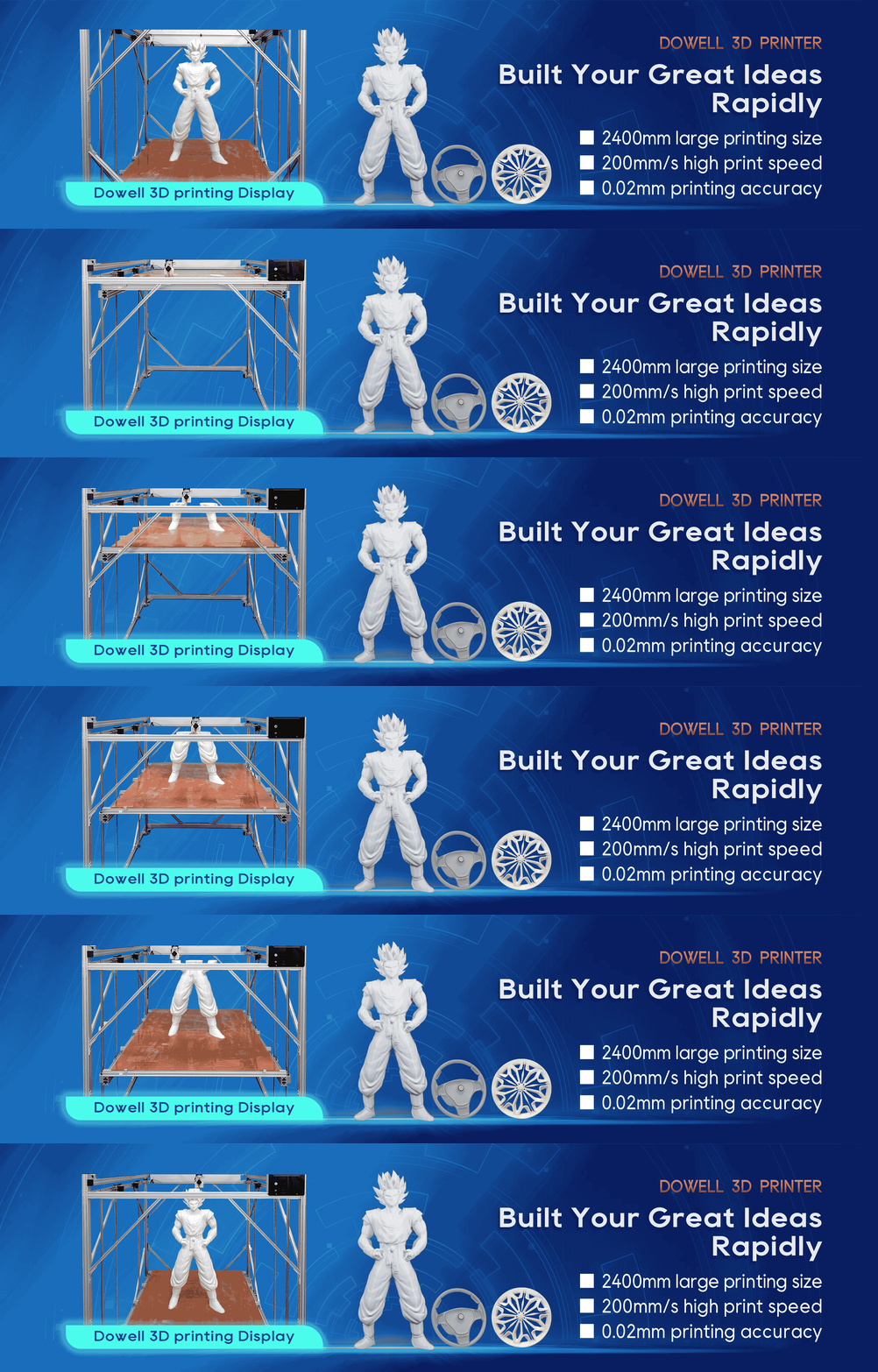
For example, DOWELL3D's current large-format industrial machines include configurations with build volumes
reaching 1800 × 2400 × 1600 mm, high-temperature extrusion, automatic leveling, and precision linear motion
systems. Some larger configurations also offer high-flow extrusion and larger nozzles for depositing more material
per pass.
The important point is not simply having a large build volume.
It is having enough machine capability to make practical use of that volume.
What This Means for Industrial 3D Printer Manufacturers
The shift toward production also changes what machine manufacturers need to deliver.
A printer cannot be sold purely as a bigger version of a desktop machine.
Industrial customers need:
Reliability.
They need to know that a long print has a reasonable chance of completing successfully.
Consistency.
The fifth part should not look dramatically different from the first.
Throughput.
The machine needs to produce enough parts to justify its place on the factory floor.
Serviceability.
When something goes wrong, downtime needs to be manageable.
Flexibility.
Different customers have different part sizes, geometries, and production requirements.
This is particularly relevant to large-format machines because the cost of a failed print can be much higher.
A failed 200 mm prototype is annoying.
A failed 1,500 mm production component after 30 hours is a production problem.
The Next Stage of Industrial 3D Printing
The industry is not abandoning prototyping.
It is simply moving beyond it.
Prototyping will remain one of the strongest applications for additive manufacturing because being able to
change a design quickly is extremely valuable.
But production is becoming a much larger part of the conversation.
Recent industry reporting points in the same direction: additive manufacturing growth is increasingly tied to
practical applications and measurable production value rather than the earlier period of broad experimentation.
The Association For Manufacturing Technology noted in 2026 that AM growth is becoming more closely connected
to production applications across aerospace, defense, medical, and industrial markets.
That is a healthier stage of development.
Instead of asking whether 3D printing is "the future," manufacturers are asking a much more useful question:
Where does it make financial and operational sense today?
Conclusion: The Best Industrial 3D Printer Is the One That Fits the Production Job
The future of industrial 3D printing probably will not be defined by a single breakthrough specification.
It will be defined by whether manufacturers can turn a digital design into a reliable physical part with less time,
less waste, fewer production steps, and a reasonable cost.
For some companies, that may mean a compact production machine.
For others, it may mean a large format 3d printer capable of producing full-size components, molds, fixtures, or
tooling without splitting them into multiple pieces.
For applications where dimensional consistency matters, a high precision 3d printer becomes more important.
And when the machine is expected to run as part of a manufacturing workflow rather than occasionally in an R&D
lab, an industrial 3d printer needs to be evaluated on much more than print resolution.
The real trend is simple:
3D printing is moving from "Can we prototype it?" toward "Can we manufacture it?"
The right question is not simply which 3d printer has the biggest build volume or the highest advertised speed.
It is:
Which machine can reliably make the parts your factory actually needs?
That is where industrial 3D printing starts to become manufacturing—not just prototyping.