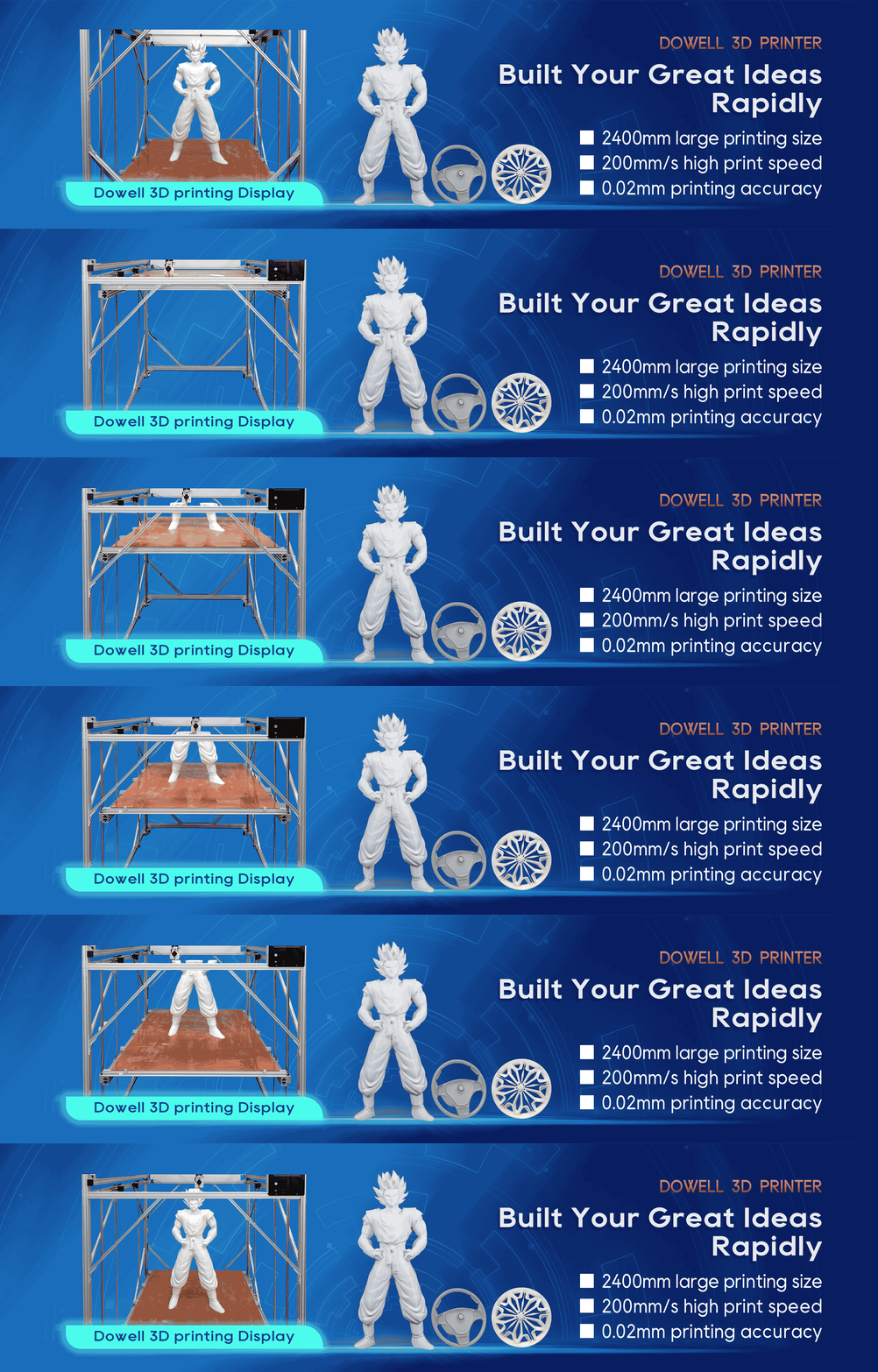
Exploring the Benefits of 3D Printing in Prototyping
In product development, prototyping is a crucial stage. Rapid prototyping allows engineers to turn ideas into
reality much faster, transforming CAD files into physical parts in just a few days. With 3D printing technology,
you can test, refine, and perfect your designs without the time and effort required by traditional methods.
Let's delve into the key advantages of using 3D printing, particularly filament-based 3D printing, for prototyping,
helping you stay ahead of the competition.
1. Cost-Effective Prototyping
Traditional methods of prototyping can be expensive, especially when dealing with low-volume production.
The cost of materials, tooling, and machine setup can add up quickly, making it difficult for small businesses or
startups to afford rapid prototyping. 3D printing, however, offers a more affordable alternative. With the use of
filament-based 3D printers, businesses can produce prototypes at a fraction of the cost compared to conventional
methods. The primary materials, such as PLA, ABS, PETG, and other filaments, are relatively inexpensive, and
there's no need for complex machinery or molds.
2. Faster Time to Market
One of the most significant advantages of 3D printing in prototyping is speed. Traditional prototyping methods
can take days or even weeks, especially when tooling or molds are required. In contrast, 3D printing can complete
a prototype in hours.
Same-day iterations: A digital CAD file can be converted to G-code and printed within hours.
Parallel prototyping: Multiple design variations can be printed simultaneously, allowing teams to compare options
side-by-side.
Overnight production: Start a print before leaving work and have a functional prototype waiting the next morning.
Using filament-based 3D printers, you can print prototypes overnight, accelerating testing and iteration. This
translates to shorter development cycles and faster time to market, crucial in today's competitive business
environment.
3. Design Flexibility and Complexity
3D printing offers unparalleled design flexibility. Unlike traditional manufacturing methods, which may require
multiple components, manual assembly, and specialized molds if you want complex internal structures, organic
shapes, or parts with moving parts, 3D printing can create highly detailed and complex prototypes without
additional costs. This is particularly advantageous for testing designs with complex features, interlocking parts,
or internal structures that are difficult or impossible to achieve using traditional methods. Filament-based
3D printers also offer excellent control over resolution and detail, making them ideal for prototyping that
requires high-precision tolerances.
Part Consolidation
One of the most powerful applications is part consolidation—combining multiple components into a single printed
piece. A product that previously required 10 separate parts, fasteners, and assembly can now be printed as one
integrated unit. This approach:
Reduces assembly time
Eliminates weak points (joints and fasteners)
Simplifies supply chains
Lowers overall costs
Geometrical Freedom
Filament extrusion allows designers to explore geometries that are impossible to machine or mold :
Internal cooling channels
Organic, biomimetic structures
Lattice frameworks for weight reduction
Undercuts and overhangs (with proper support)
As one industry observer notes, "AM can create these complex geometries in a single print", opening design
possibilities that were previously unimaginable.
4. Customization and Low-Volume Production
For industries requiring small production runs or custom prototypes, filament-based 3D printing is ideal. Whether
it's for limited-edition products, small-batch production, or bespoke designs. 3D printing allows businesses to create
unique prototypes or low-volume products without the need for expensive molds or tooling. This makes it easier to
test market reactions, gauge customer preferences, and produce custom designs for individual clients, all while
keeping costs down.
Applications:
Medical: Patient-specific anatomical models for surgical planning
Consumer goods: Ergonomic testing with different hand sizes
Automotive: Customized interior components for different vehicle models
Industrial: Application-specific jigs and fixtures
5. Material Diversity: Matching Properties to Purpose
Filament-based 3D printing offers a wide variety of materials, each with its own set of properties suited to different
prototyping needs.
Standard Prototyping Filaments
PLA: Ideal for rapid concept models, form/fit checks, and aesthetic evaluations. Prints easily with minimal warping.
PETG: Combines ease of printing with improved strength and chemical resistance—perfect for functional prototypes.
ABS/Tough PLA: Offers durability for prototypes that will undergo handling or basic mechanical testing.
Whether you're creating a concept model, a durable functional prototype, or a flexible component, there is a
filament that fits your needs. This flexibility ensures that 3D printing can accommodate a wide range of industries
and applications, from automotive to consumer goods, electronics, and medical devices.
6. Iterative Testing and Refinement
In the prototyping process, iteration is key. Engineers and designers often need to make adjustments to the design
based on real-world testing. With 3D printing, iterative prototyping becomes much easier and more affordable. Since
filament-based 3D printers can produce prototypes quickly and at a lower cost, multiple iterations can be tested in a
short period of time. This allows for faster identification of design flaws and more precise refinement of the product,
resulting in a higher-quality final product.
Why Choose DOWELL3D for Your 3D Printing Needs?
At DOWELL3D, we have over 12 years of experience in the 3D printing industry, specializing in high-quality 3D
printers and filaments. Whether you're looking for FDM or FGF 3D printers, we offer a range of options that meet
the needs of both hobbyists and professionals. Our filaments, including PLA, PETG, and ABS, are designed for
optimal performance and durability, ensuring you get the best results for your prototypes. With our expertise
and dedication to quality, DOWELL3D is your trusted partner in taking your prototyping process to the next level.
Conclusion
3D printing has significantly transformed the prototyping process, offering cost-effective, fast, and highly flexible
solutions that traditional methods simply can't match. Whether you're a startup looking to bring a new product
to market or an established company looking to refine your designs, filament-based 3D printing is the tool you
need. With DOWELL3D's top-tier 3D printers and filaments, you can be confident in the quality and efficiency of
your prototyping process.