High Throughput 3D Printer: Faster Production, g/h vs mm/s
Speed and output are different quantities, and buyers mix them up weekly. A machine can print at 500mm/s
on paper and still deliver fewer kilograms per shift than a slower machine on the same part — the gap that
decides whether a high speed 3d printer pays for itself.
Christophe Paulo of DuPont said in 2019, "the bulk of the material extrusion market will be in pellet to parts"
(3dprint.com, RAPID 2019 interview). Output, measured in kilograms per hour, decides whether a part gets
printed at all.
If you are specifying a high throughput 3d printer for faster production, a spec sheet will not answer the question.
What "Throughput" Actually Measures
g/h is a mass rate; mm/s is only speed
Throughput is quoted in grams per hour; motion is quoted in millimeters per second. The link is arithmetic:
g/h ≈ extrusion cross-section × linear speed × material density
Cross-section comes from nozzle diameter, layer height, and extrusion width. Any g/h vs mm/s 3d printer
comparison that skips geometry compares two different things.
Same mm/s, different kilograms
Two machines at 250mm/s do not produce the same mass. A 0.8mm nozzle laying a thick bead deposits far
more material per second than a 0.4mm nozzle laying a fine one. This is where most 3d printer throughput
vs layer height confusion starts: layer height is one multiplier.
Sustained throughput is the only number that pays
Ask what nozzle, layer height, and extrusion width a figure was measured at, how long the machine held it,
and whether it came from hour one or hour twenty. A peak number describes a moment; sustained throughput
describes a shift. That is the practical meaning of sustained vs peak throughput 3d printing.
Where Real Throughput Comes From: Four Systems
Four systems set what a high throughput 3d printer delivers — extrusion, nozzle, motion, material path.
The weakest caps the other three.
Extrusion system: melting versus screw plastication
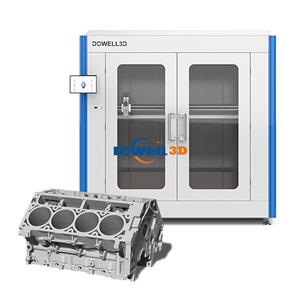
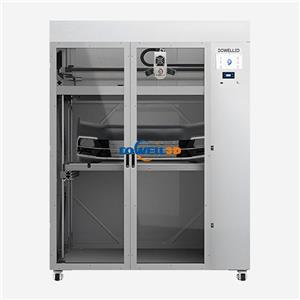
A filament machine melts a strand on demand, and the melt rate caps output — 400g/h on DS/DMplus, 1,000g/h
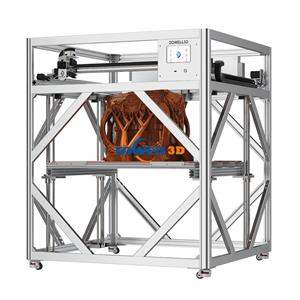
on DMpro. A high flow 3d printer of the pellet kind drives a screw instead; the DP-A series features an automatic
feeding system and can achieve extrusion rates of 4,000–5,000 g/h.
Nozzle and bead: the size of what comes out
Nozzle diameter is fixed at purchase: 0.4/0.6/0.8mm on the entry series, 0.8/1.2/1.6mm on DMpro and DL,
1.0/2.0/3.0mm on the pellet machines. A bigger bore trades surface detail for grams per second.
Motion system: speed is a ceiling, not a promise
Printing speeds read 150-500mm/s on the entry series, 250-500mm/s on DMpro, DL, and DF, and 0-300mm/s
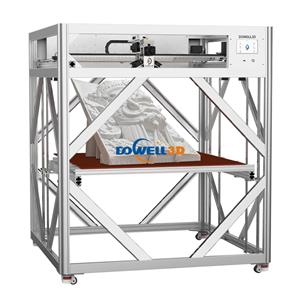
on the pellet line — ceilings, not averages. The DL series pairs an 80mm heavy-duty frame with brake motors
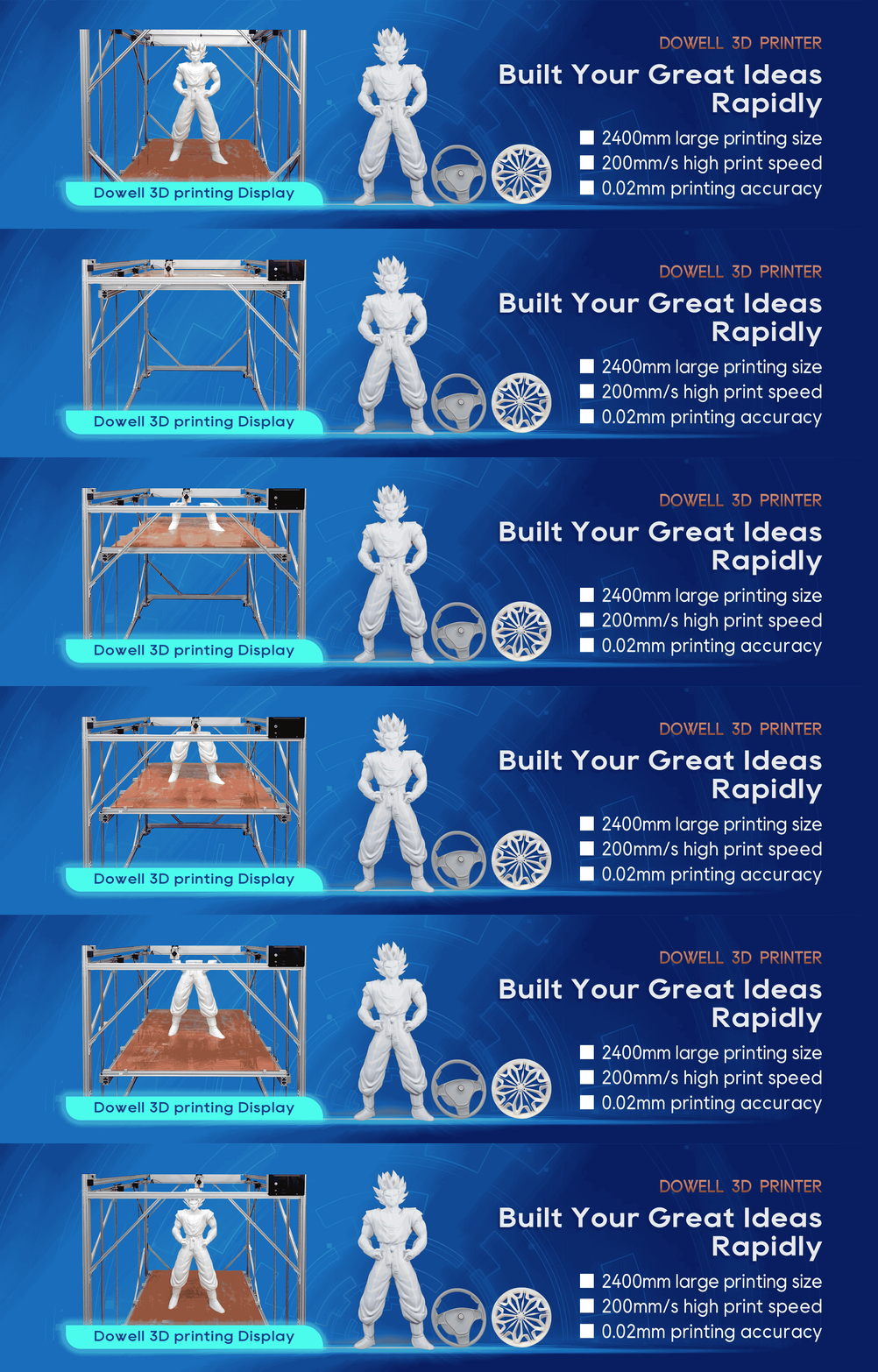
and holds 0.02mm positioning across a 1,800 × 2,400 × 1,600mm envelope.
Material path: dry filament is a throughput component
Moisture-laden filament prints slowly, not just poorly: operators drop the temperature, slow the feed, and
stop the line to swap spools. On continuous 3d printing for long jobs, moisture is a throughput loss wearing
a quality label — see our article on filament drying.
Throughput, Lead Time, and Cost per Part
Lead time is a throughput equation
3d printing lead time reduction is mostly division: halve effective output and every delivery promise doubles.
Shops that move from filament to pellet output do not just print faster — they requote, and a large format 3d
printer for production parts stays busy enough for a second shift.
Where chasing throughput stops paying
Small parts leave a machine waiting on travel and cooling, so both tiers can finish them in the same wall-clock
time. Fine detail needs a smaller nozzle, capping bead size by geometry. Buy throughput where part weight is
on your side.
Availability is the other half of throughput
Effective output is sustained g/h multiplied by uptime. A machine rated 1,000g/h delivers that figure multiplied
by availability, not by the calendar; on a large format 3d printer, idle time burns delivery promises. The market
reflects it: printing services grew 15.5% in 2025 while hardware grew 3.6% (ASTM International, Feb 16, 2026).
Downtime does not shave throughput; it zeroes it, which is why spare parts and response time count as throughput
features in our after-sales piece.
Conclusion
Throughput is not speed. It is effective sustained output multiplied by the share of the calendar the machine runs —
the number that sets lead time and cost per part. Buy the tier that matches your part weight and volume, and
ask what the sustained figure was measured at. A high-speed industrial 3d printer that stops is a slow one; an
industrial 3d printer that drifts is merely hurried.
Send your part weight, material, and monthly volume — DOWELL engineers will match a machine tier and return
the estimated print hours.